
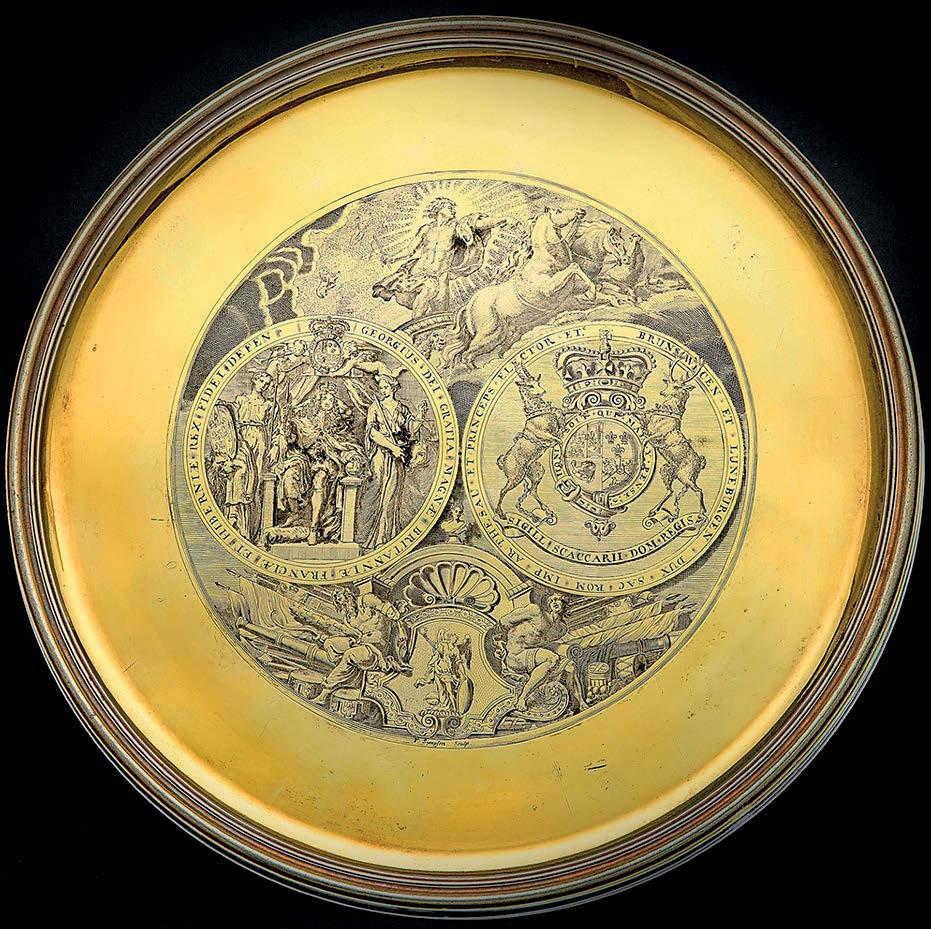
Sir Robert Walpole’s first seal salver, $190,000 (£140,500) at Doyle.
The historic piece of Georgian silver – the ‘pair’ to the famed Walpole seal salver in the Victoria and Albert Museum – was offered at the May 13 English and Continental Silver auction at Doyle with a guide of $80,000-120,000. With buyer's premium included, the selling total was $241,800.
Todd Sell, silver specialist at Doyle, said phone bidders led the fight for the salver. “We had institutions, we had private buyers, we had English and American trade.” The successful buyer wished to remain anonymous.
The piece came to light during an estate appraisal. “The salver had been in the family for almost 100 years, and they did not have any information about it,” said Sell. “The quality of the engraving jumped out immediately, even through decades of tarnish.
“This led to a search for a signature, which we could just make out as I. Sympson sculp. Once we started researching it, the Walpole connection became clear.” The 14in (35cm) circular salver – fashioned in 1717 as a tazza with a pedestal foot – is the earlier of two pieces of seal silver commissioned by Sir Robert Walpole (1676-1745) to mark his terms as First Lord of the Treasury and Chancellor of the Exchequer, from 1715-17 and again from 1721-27.
It combines the talents of the London silversmith William Lukin and Joseph Sympson I, an engraver and printshop owner working in London’s West End from c.1710-50. The design was known from an ink impression that survives in the British Museum.
It was taken by the caricaturist George Cruikshank in 1842 during the famed contents sale at Strawberry Hill, former home of Horace Walpole (1717-97).
Walpole’s second seal salver (a square shaped form) was made by the Paul de Lamerie workshop in 1728 with the engraved work attributed to the artist William Hogarth. This is the piece acquired by the V&A in 1956 that – now displayed in the British Galleries – is among the best-known pieces of English silver.
‘Seal silver’ was fashioned from the matrices of seals of office that become obsolete – typically with a change of monarch.
According to a tradition dating back to the Tudor period, when a seal became obsolete, the matrices were defaced and then returned to the office holder, as a perquisite (or perk). A piece of silver was then commissioned and engraved with the designs of the official seals.
Thirteen seal salvers, all characterised by exceptionally fine engraving, have been documented.