
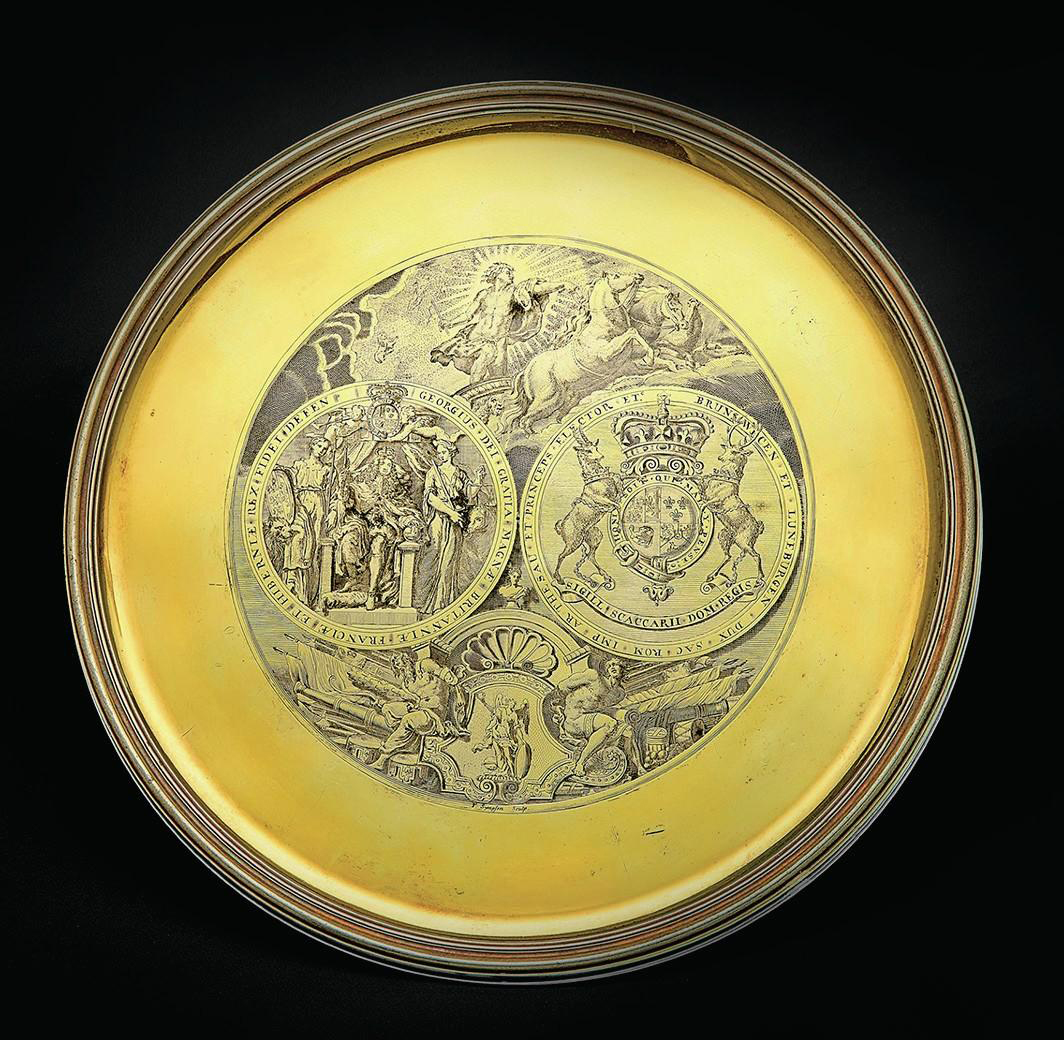
The Walpole seal salver will headline Doyle’s May 13 auction in New York, guided at $80,000-120,000.
It forms part of the May 13 English and Continental Silver sale at Doyle and is estimated at $80,000-120,000.
Todd Sell, silver specialist at Doyle, said the piece came to light during an estate appraisal.
“The salver had been in the family for almost 100 years, and they did not have any information about it,” he said. “The quality of the engraving jumped out immediately, even through decades of tarnish. This led to a search for a signature, which we could just make out as I. Sympson sculp. Once we started researching it, the Walpole connection became clear.”
The 14in (35cm) circular salver – fashioned as a tazza with a pedestal foot – is the earlier of two pieces of seal silver commissioned by Sir Robert Walpole (1676-1745) that marked his terms as First Lord of the Treasury and Chancellor of the Exchequer, from 1715-17 and again from 1721-27.
It is hallmarked for the London silversmith William Lukin (1717) with the spectacular armorial engraving done by Joseph Sympson I, an engraver and printshop owner working in London’s West End from c.1710-50. A scratched inscription to the base reads Geo I 1717-1724.
V&A salver
Walpole’s second seal salver (a square shaped form) was made by the Paul de Lamerie workshop in 1728 with the engraved work attributed to William Hogarth.
This is the piece acquired by the V&A in 1956 that – prominently displayed ever since – is among the best-known pieces of English silver.
Doyle’s salver, presumably ordered when Walpole’s first term of exchequer ended, was known from an ink impression that survives in the British Museum.
It was taken by the caricaturist George Cruikshank in 1842 during the famed contents sale at Strawberry Hill, former home of Horace Walpole (1717-97).
Edward Smith-Stanley (1775-1851), the 13th Earl of Derby, placed the top bid, and it remained in his family until the 18th Earl sold it in the 1940s. It has been in a private New York collection since then.
Sell deems it “magnificent in person” and says “the engraving is still spectacularly crisp – it’s remarkable”.
“The joy of this job is when something ‘lost’ suddenly comes back to life and you get to share it with the world. To give the family the news about their treasure really was a highlight of my career.”
Walpole’s silver
Regarded as Britain’s first prime minister, Robert Walpole – widely known as ‘Cock Robin’ – was also among the most sophisticated and astute collectors of his era.
Christopher Hartop’s article Sir Robert Walpole’s Silver published by The Silver Society in 2014 reveals Walpole’s huge holdings of silver and documents the interconnected relationship between his favoured silversmith William Lukin, the engraver Joseph Sympson, and the ‘goldsmiths bankers’ Daniel and Joseph Norcott.
Other Walpole works with connections to both Lukin and Sympson include a covered cup, marked by Lukin and signed by Sympson in the Metropolitan Museum of Art, New York.
Seal silver
‘Seal silver’ was fashioned from the matrices of seals of office that had become obsolete – typically with a change of monarch.
According to a tradition dating back to the Tudor period, when a seal became obsolete, the matrices were defaced and then returned to the office holder, as a perquisite (or perk). A piece of silver was then commissioned and engraved with the designs of the official seals.
Dr Tessa Murdoch’s research on the subject cites the making of a covered cup from Mary I’s great seal in 1574 as the first recorded instance of this practice.
Salvers superseded cups as the plate of choice around 1700, with the first made from the Exchequer Seal of William and Mary. Murdoch has documented 13 seal salvers, all characterized by exceptionally fine engraving, in public and private collections.
Several other examples have been offered at auction in recent memory. In June 2010, Christie’s London sold a 1721 seal salver by Paul de Lamerie, which realised £80,000. The two Eyre salvers, commissioned by Sir Robert Eyre (1666-1735) and dated 1728 and 1735, and a 1728 salver commissioned by Peter King, 1st Baron King (1669-1734) were offered by Sotheby’s in November 2008 and July 2017 respectively.
Both were unsold with guides of £150,000-250,000.
Todd Sell described the $80,000-120,000 estimate on Walpole’s first seal salver as “cautious, with the market not being as aggressive as it once was”.