
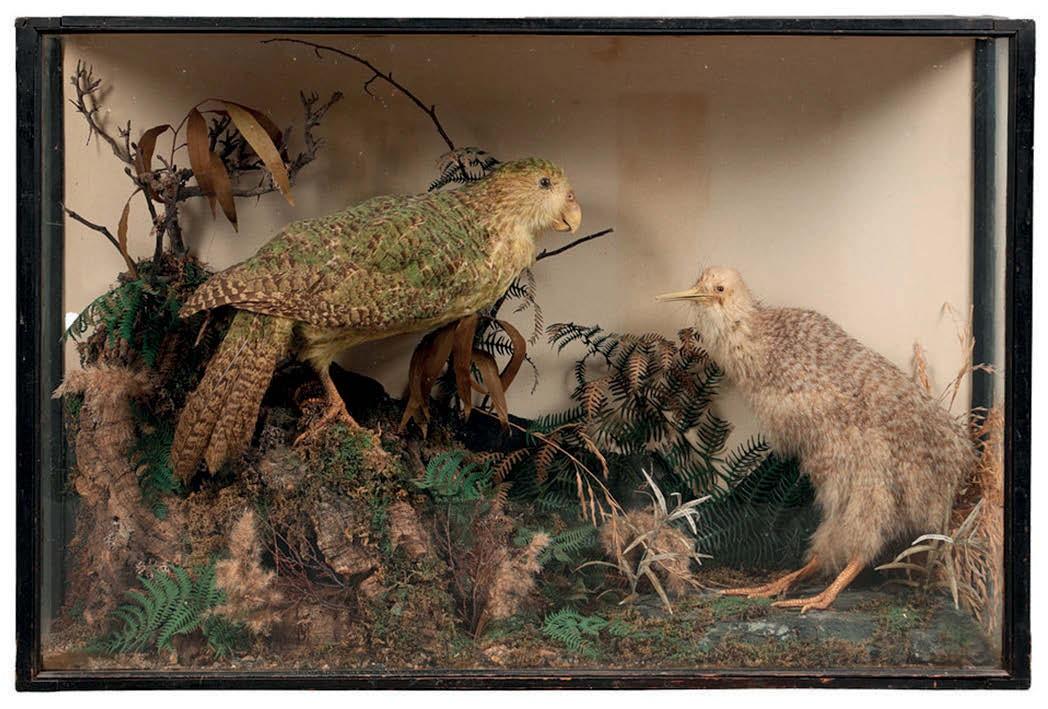
Victorian taxidermy case of a kakapo and a great spotted kiwi, £12,000 at Bishop & Miller.
A great spotted kiwi and a kakapo were both mounted in a naturalistic setting by the Bristol taxidermist HJ Charbonnier.
Before the great spotted kiwi was known to science, several stories circulated about the existence of a large kiwi the Maori called roroa. It was not until 1871 that two specimens were brought to the Canterbury Museum and identified as a new species.
The population started declining when European settlers first arrived in New Zealand. Today fewer than 16,000 birds survive almost all in the more mountainous parts of north-west Nelson, the north-west coast and the Southern Alps.
Rarer still is the flightless ground-dwelling parrot known by its Maori name kakapo. First formally described and illustrated in 1845 by the English ornithologist George Robert Gray, as early as the 1890s conservation efforts were under way to prevent its extinction. The current population of living individuals is 237, confined to four small New Zealand islands.
The rare case, estimated at £2000-3000, sold to a UK collector at £12,000 (plus 25% buyer’s premium).
Bishop & Miller said it was very much business as usual for the north Norfolk saleroom following the staff changes reported in last week’s issue (ATG No 2716).