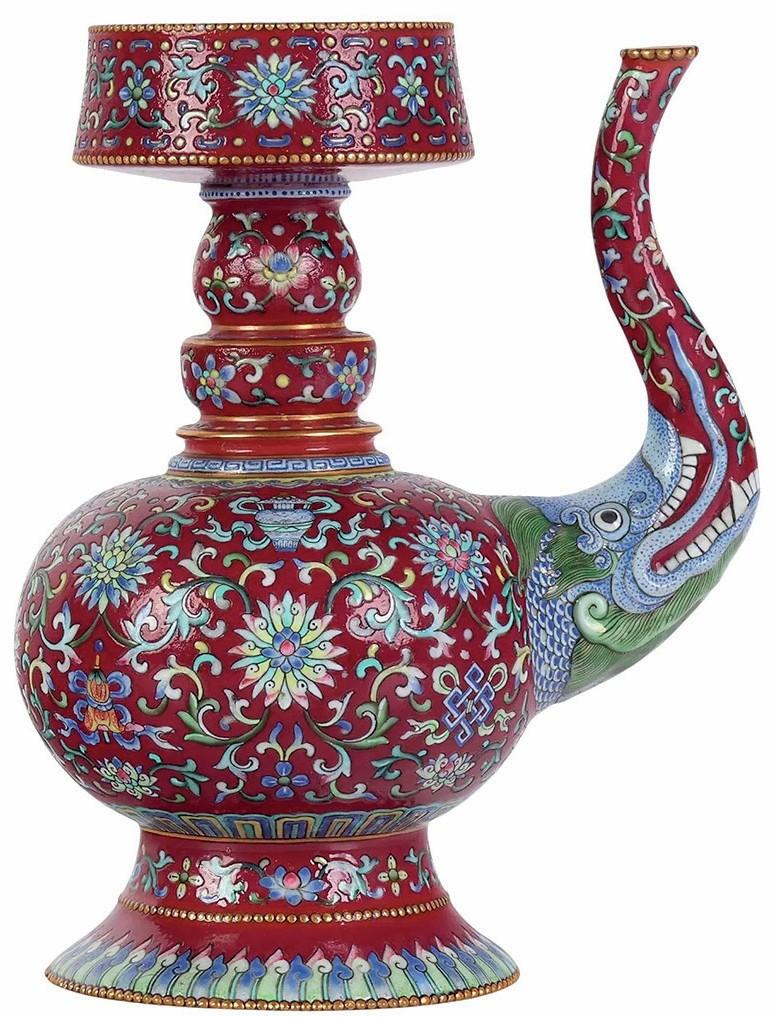
Qianlong mark famille rose pemba hu, $200,000 (£143,600) at Hill Auction Gallery.
Ewers of this distinctive form with a curved spout issuing from the moulded makara head are known as pemba hu. Imitating the Tibetan metalwork, they were first made in the 22nd year of the reign of the Qianlong emperor (1757) for use on the Buddhist altars in the palaces and temples of Beijing and Chengde, or as gifts for Tibetan lamas visiting the court.
They were produced in a wide range of different forms and colours across the 18th century and this example is richly decorated with the bajixiang (the Eight Auspicious Symbols) on a ruby ground, with the base carrying a red six-character seal mark against a turquoise ground.

Qianlong mark famille rose pemba hu, $200,000 (£143,600) at Hill Auction Gallery.
Pemba hu have been much reproduced in later periods and bring markedly different sums depending upon the perceived date. The price for this example was consistent with a Qianlong period piece.
Bowls wow bidders
Chinese works of art continue to make for pleasant surprises across the US auction scene. On September 12, the Rockville, Maryland, saleroom Weschler’s (29% buyer’s premium) sold a pair of eggshell porcelain famille rose ‘chrysanthemum ‘ bowls for $100,000 (£76,700) against a guide of $800-1200.
Weschler’s was told that the bowls had been rejected by a major auction house in New York.
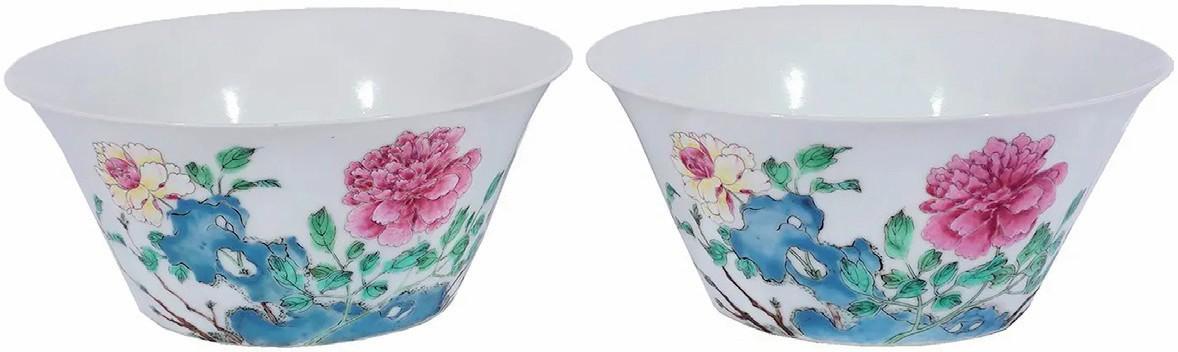
Yongzheng mark famille rose chrysanthemum bowls, $100,000 (£76,700) at Weschler’s.
The lot notes stated the 7in (17cm) bowls bore Yongzheng (1722-35) marks but probably dated to the Republic period. However, it appears that more than one bidder thought they were of the period.
While it was not included in the lot photos, a valuation document from Stair Galleries dated July 1983 was offered with the bowls that stated they were early 18th century and valued at $2000.
Pre-sale interest was strong. The house honoured 13 requests for condition reports (one bowl had a hairline crack) and these items were a clear favourite at the exhibition prior to the sale. The victor hailed from New York City and participated via the LiveAuctioneers platform.