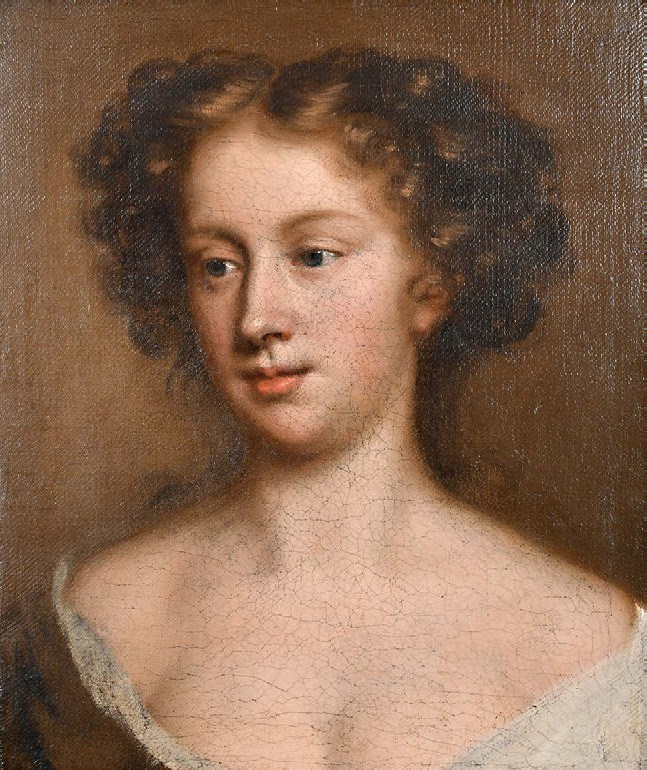


Sold for an auction record £11,500 at Forum was this copy of George de La Chappelle’s Recuel de divers portraits des principales dames de la Porte du Grand Turc in 1648 with its fine engraved portraits of ladies of the Ottoman court.
A rare 17th century book of female costume of the Levant by George de La Chapelle (fl.1638-48) was a highlight of a single-owner collection of historical and illustrated books on the Ottoman world offered at Forum (26/25/20/12.5% buyer’s premium) on November 14.
La Chapelle, a native of Caen in Normandy, lived in Constantinople, modern-day Istanbul, for several years in the 17th century accompanying the French envoy Le Haye. La Chapelle produced many drawings during his residence and when he returned to France he had a selection of his drawings engraved and published as Recuel de divers portraits des principales dames de la Porte du Grand Turc in 1648.
The book illustrated with 12 fine engraved plates depicts portraits and costume of Turkish, Persian, Russian, Armenian, and Greek women resident in Constantinople.
La Chappelle explained that he was inspired to produce his work in response to the poor artistry he had seen in a Turkish history by Laonikos Chalkokondyles. In contrast, La Chapelle’s elegant full-length portraits portray the elegantly costumed women against a panoramic backdrop of the city of Constantinople, with the copper engravings showing the attention to detail of the fabrics, embroidery, jewels and adornments.
It is a rare work, and Forum stated the last copy sold at auction was in 1967. That may have been the only other copy recorded, as it would appear that the Forum copy was the copy sold in a single-owner sale at Sotheby’s in 2008 (Greece and the Levant: a private library) for £5750 (including premium). This time the book sold for double that price in Battersea to set a new auction record of £11,500 hammer.
Ottoman doomsayer
Another work that set a new auction record in the sale was a first English edition of Demetrius Cantemir’s History of the Growth and Decay of the Othman Empire (1734-35).
The author was born in Moldavia and between 1687 and 1710 spent most of his time as a hostage or envoy in Constantinople where he learned Turkish and studied Ottoman history, in addition to Persian and Arabic. In 1710, believing mistakenly that the Ottoman Empire was about to fall, he went to Russia to join Peter the Great where he wrote his history in Latin. The manuscript was later taken to England where it was translated and published, becoming a standard history for almost a century.
Estimated at £1000-1500, the copy sold for a record £6000 hammer.
Cassas takes top sum
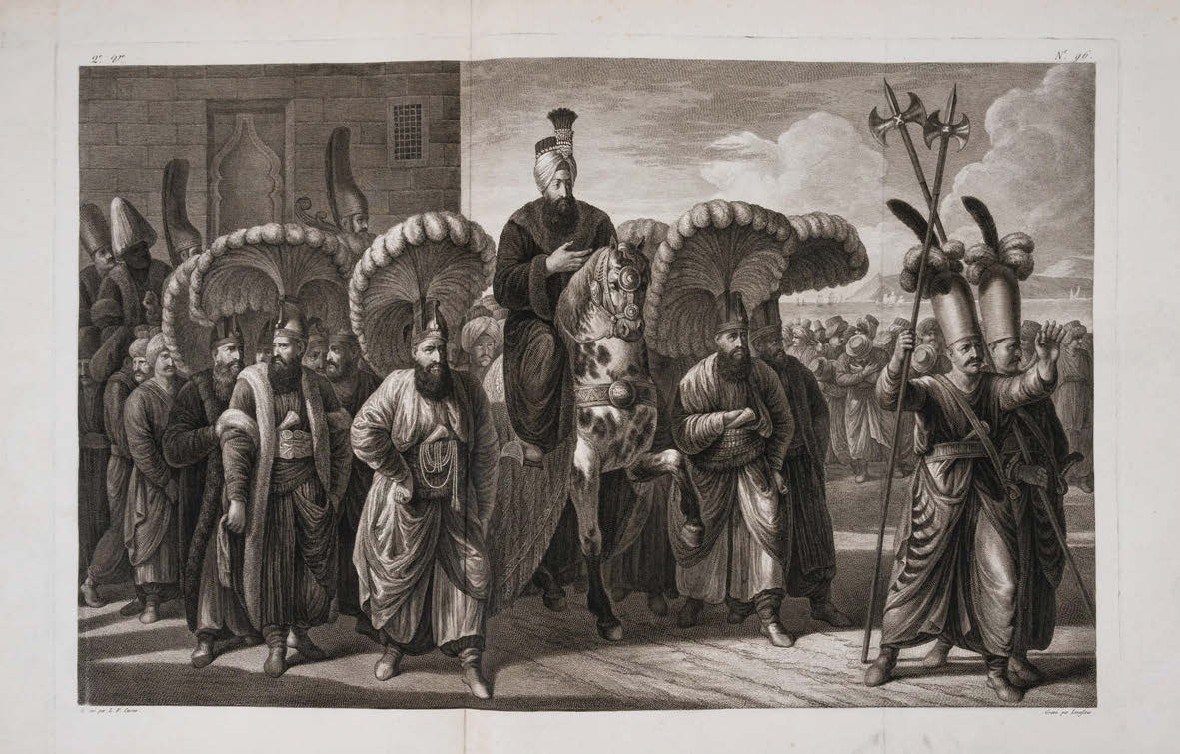
The top price in the Forum sale was achieved for a complete copy of Louis François Cassas’s late 18th-century work Voyage Pittoresque de la Syrie, de la Phoenicie, de la Palestine et de la Basse-Égypte (1799) which sold for £17,000, helped perhaps by the fine early impressions of the plates.
A three-volume set of Louis François Cassas’ late 18th-century work Voyage Pittoresque de la Syrie, de la Phoenicie, de la Palestine et de la Basse-Égypte (1799) realised the top price in the sale at £17,000 which was more than double the low estimate, and the third-highest price recorded at auction, helped by the prints being strong early impressions.
Cassas accompanied Choiseul-Gouffier on his embassy to Constantinople in 1784 and travelled in the Levant until 1787. The 180 richly engraved plates show views in Syria, Lebanon, Egypt and Cyprus, and include depictions of grand ceremonial processions and dramatic scenes.
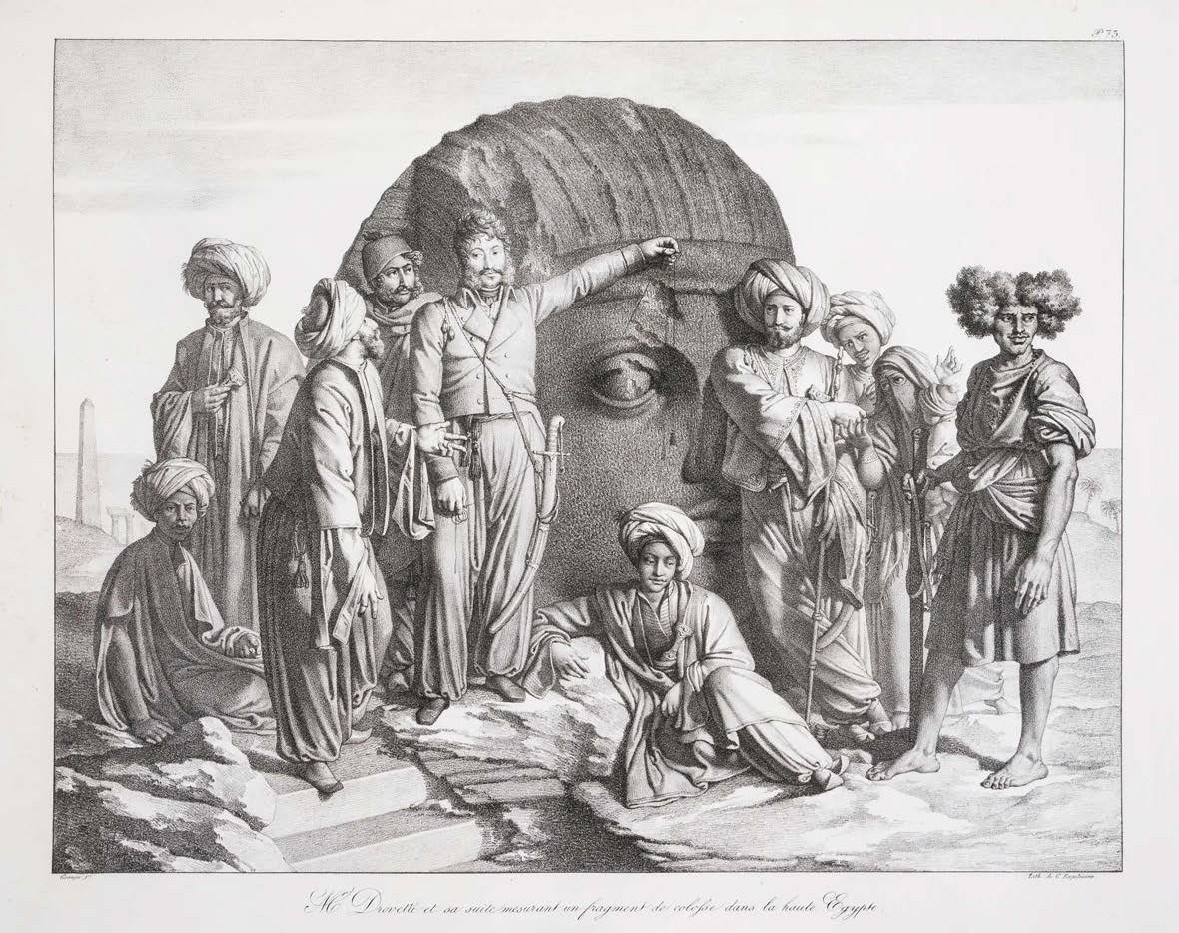
The French artist and antiquarian Louis de Forbin’s Voyage dans le Levant (1819) records his travels in the Levant in search of antiquities. This impressive publication was bid to the high estimate of £8000 at Forum.
In 1817 the French painter and antiquary Louis de Forbin travelled with a party of artists and scholars to the Levant to purchase antiquities. Their travels took them to Athens then to Turkey, the Holy Land and finally to Egypt.
The resulting publication Voyage dans le Levant (1819) published by the French royal printing house was one of the first French books to use lithography on a large format scale and included no fewer than 70 lithographs among the 80 plates.
Due to costs the print run was limited to 325 copies and examples are now uncommon at auction. The winning bidder at Forum drove the price to the top estimate of £8000.
Hagia Sophia restored
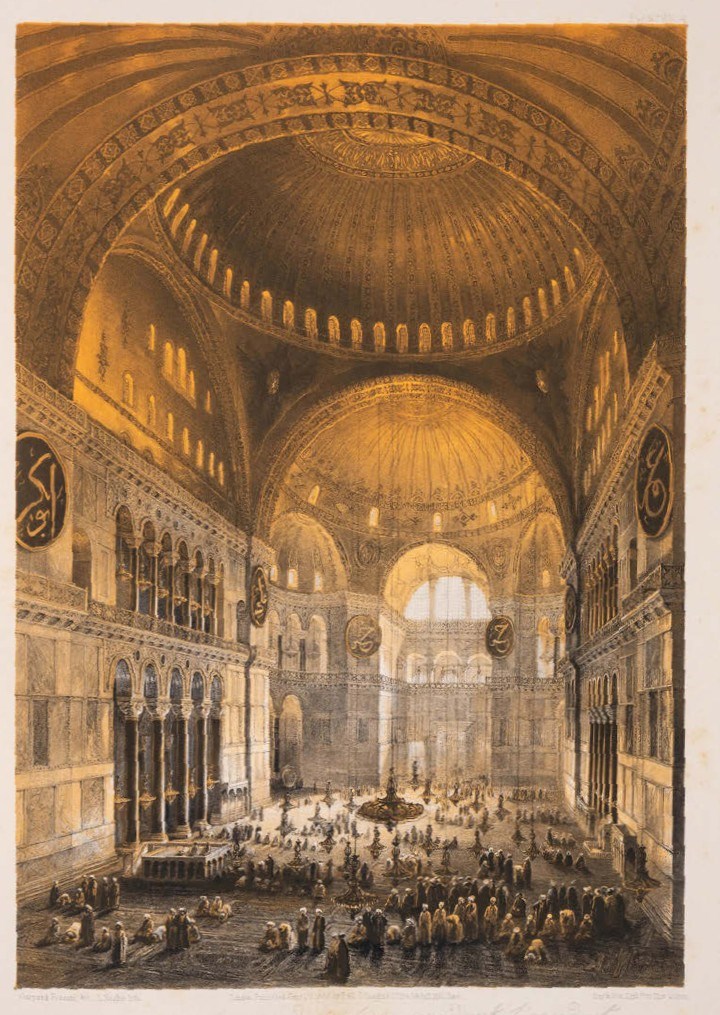
The magnificent Hagia Sophia in Istanbul draws an average of 50,000 daily visitors and Fossati’s fine publication on the 19th century restoration attracted bids up to £9000 at Forum..
One of the most famous buildings in Constantinople is the Hagia Sophia, originally built by the Byzantine emperor Justinian I as a cathedral in the 6th century. Following the fall of Constantinople in 1453 it was converted to a mosque.
In the mid-19th century Sultan Abdulmejid I ordered its restoration which was carried out by the Swiss- Italian Gaspare Fossati and his brother Giuseppe who spent two years restoring the ancient building.
The newly restored mosque was celebrated and recorded in a fine folio volume of 25 lithographs which was published in editions with tinted or hand-coloured plates.
The Forum copy with tinted plates depicting the interior and exterior of the mosque sold above estimate at £9000.
Notable works among the many illustrated books in the collection included a possibly later hand-coloured edition of John Frederick Lewis’ Illustrations of Constantinople (1838) with 27 lithographs after drawings by Coke Smyth which sold at the lower end of the estimate at £6000.
Brindesi at the double
Two works by the artist Jean Brindesi were offered, the first being a volume of 20 chromolithographed views titled Souvenirs de Constantinople (1855-60) which realised £4000, and a companion volume of 22 colour costume plates by the same artist titled Elbicei Atika Musée des Anciens Costumes Turcs de Constantinople (c.1855) which sold for £3000.
Costume coverage
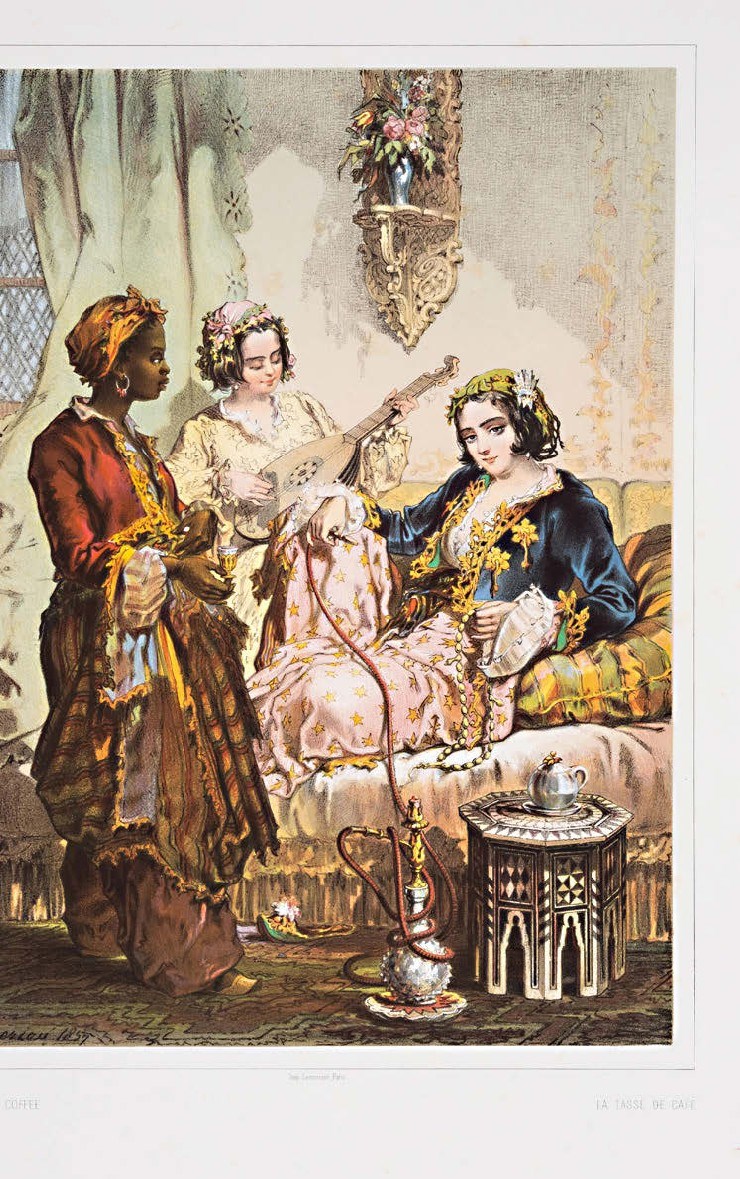
Amedeo Preziosi’s striking colour portraits in Stamboul: recollections of Eastern Life (1858) sold for £5000 at Forum.
Many costume books appear to reproduce very similar ‘types’ of Ottoman costume that can be traced back to 16th century works; however, the 19th century artist Amedeo Preziosi produced highly original drawings of people on his travels in Turkey and Egypt and the bright chromolithographs are certainly eye-catching. Lead cataloguer of the sale Rhiannon Spence said that the collector had spent many years tracking down good examples of Preziosi’s works.
The first, Stamboul: recollections of Eastern Life (1858), which contains 29 colour plates of portraits of Turkish subjects, was purchased in 2012 at Sotheby’s New York in the sale of the library of Jacques Levy where it sold for a premium-inclusive $14,375. This time around the work sold on the low estimate for a hammer of £5000 and his Souvenir du Caire (c.1862) realised £3500.
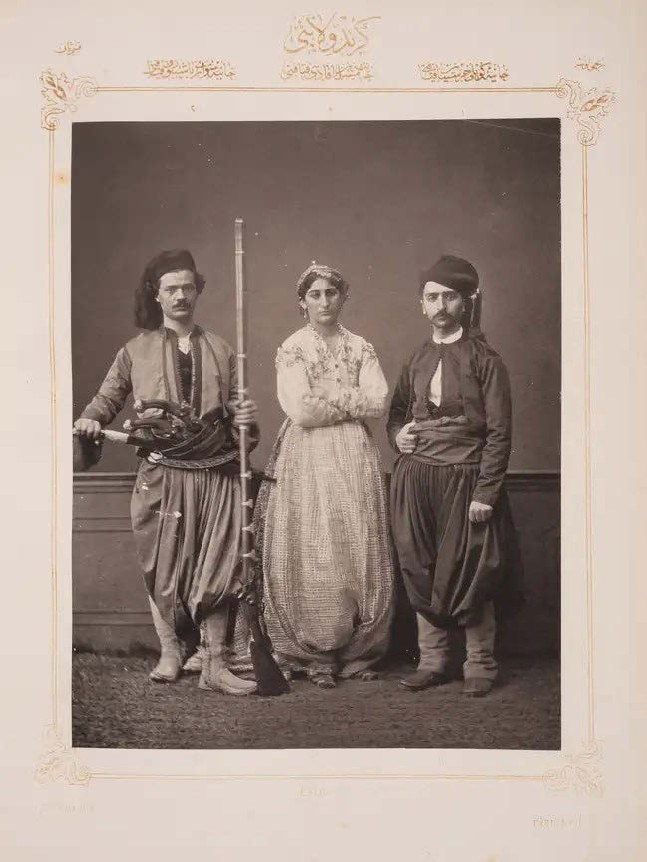
Marie de Launay and Hamdy Bey’s photobook on people of the Ottoman World: Les Costumes Populaires de la Turquie en 1873 saw bidders battling it out to more than double the top estimate at £6500 at Forum.
The most well-known 19th century photobook of costume of the Ottoman Empire is Marie de Launay and Hamdy Bey’s Les Costumes Populaires de la Turquie en 1873 which contains 74 photographic plates after photographs by Pascal Sébah. The three parts include portraits from Turkey, Greece, Cyprus, Crete, Rhodes, as well as Mecca and the Hejaz in the final part.
The copy offered in original printed wrappers was guided at £2000-3000 and sold for more than double the top estimate at £6500.
Wide interest
Spence said that there had been wide interest in the sale from bidders in Turkey and Greece along with regular bidders and the sale attracted new buyers. It resulted in 72% of the lots being sold for a premium-inclusive £282,353.