

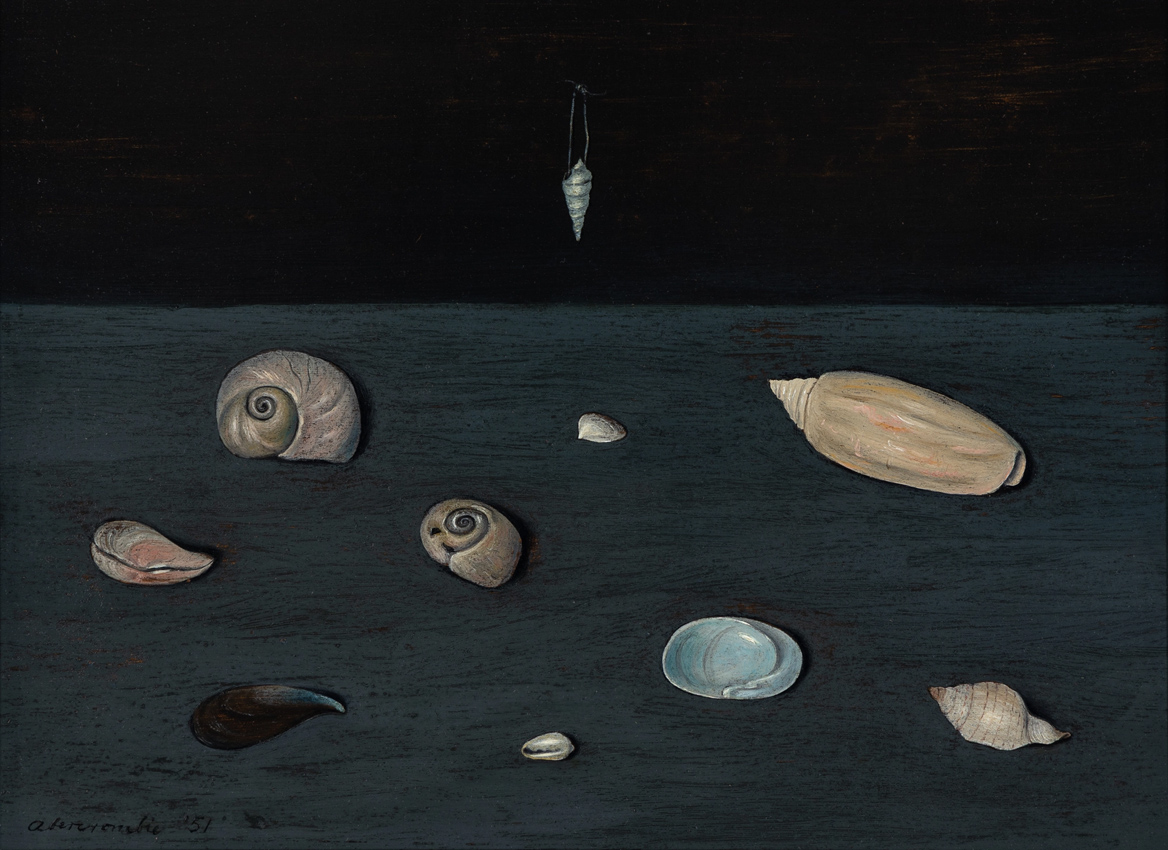
Alderman Merriam's Shells by Gertrude Abercrombie, $1.06m (£803,805) at Freeman's.
Image courtesy of Freeman's Auction, 2026
Measuring just 8 x 11in (20 x 28cm), the signed oil on Masonite from 1951 titled Alderman Merriam's Shells was estimated at $150,000-250,000 at the sale on October 1. Attracting interest from nine bidders, the lot took nine minutes to sell with the final two phone bidders both fiercely competing and jumping increments in an effort to shake off the other.
The gavel finally fell at $1.06m (£803,805) to a US collector from the West Coast who was bidding via Freeman's chief operating officer Jarrett Anistranski. It was the first time a work by the artist had ever made a hammer price of over $1m.
The price, which with buyer’s premium added was $1.35m (£1.02m), exceeded the previous saleroom high for Abercrombie – the $800,000 (£610,760) for the larger painting Message for Mercy (1950) that sold at Sotheby's New York in November last year.
Estate sale discovery
The sale of the picture represented an extraordinary rediscovery. The work had been missing from public view for 75 years but resurfaced this summer at an estate sale in Michigan.
It was spotted by “a longtime hunter of record albums and mid-century furniture, tucked in a dark hallway corner and overlooked by other buyers” according to Freeman’s, and was purchased for just $30 on the strength of the signature Abercrombie.
The new owner then found an archival photograph of this very painting in the exhibition catalogue for the recent Abercrombie retrospective at the Milwaukee Art Museum.
The painting was subsequently authenticated by leading Abercrombie scholar Dr Susan Weininger and the owner, recognising Freeman's as a sponsor of the Milwaukee exhibition, entrusted the auction house to sell it.
Symbolic subject
Alderman Merriam's Shells dates from one of the most prolific and formative periods of Abercrombie's career. It depicts an arrangement of nine sensitively rendered seashells resting on a stark, slate-gray surface, with a single conical shell suspended by a thread against a black wall, appearing to levitate above the rest.
The shells belonged to Robert Merriam, a collector of shells and alderman of Chicago's Hyde Park neighbourhood, where Abercrombie lived and worked. The painting therefore represented a rare instance of the artist working directly from life and offered new insight into her recurring shell motif.
For Abercrombie, shells carried deep symbolic weight, serving as a vessel of both protection and confinement and, with their hypnotic spiral forms, often functioning as a talisman of friendship.
The painting was very much a ‘known’ work and was exhibited extensively during Abercrombie's lifetime, appearing in six solo exhibitions in 1952 and 1953. In fact, when it appeared at an Abercrombie exhibition at Newman Brown Gallery in Chicago back in 1952, it was photographed in the Chicago Tribune’s review of the show alongside the actual shells it depicts.
In early 1952, Abercrombie gave the painting to a Michigan doctor, John Reynolds, in exchange for medical services. It remained in his collection for the rest of his life and then passed down through his estate, unseen publicly for 75 years until its rediscovery this year.
Strong market
The work’s careful arrangement of objects gave it the trademark dreamlike quality that buyers look for in Abercrombie, whose market has greatly expanded over recent years.
As well as benefitting from the increased recognition of female artists, Abercrombie’s star has also risen thanks to the reassessment of mid-century surrealist painters in America and shifting demand for certain names active in Chicago at this time.
Having once been considered primarily a regional Chicago artist, whose works previously sold for a few hundred up to a few thousand dollars, her enigmatic subjects have now become highly sought after among buyers of modern and contemporary art across the US, and her prices have expanded more than 10-fold in the last decade.
Indeed, the current sale represented the third time the auction record for Abercrombie has been broken in the last two years.
Freeman’s senior vice president and head of the Post War & Contemporary Art department Zack Wirsum said: “As happy as we are to have recaptured the record sale price for an artist we have long championed, we are even happier for our eagle-eyed consignor who saved this masterpiece from staying forever lost to time.”
Freeman's Post-War & Contemporary Art sale was deliberately timed to take place ahead of the series of November auctions in New York and was part of a strategy by new CEO Muys Snijders to shake up the traditional auction calendar and ‘to create space for collectors to focus their attention on Freeman's offerings’, according to the auction house.
Overall the sale raised a total of $3.45m (£2.62m) with 85 of the 97 lots selling (88%). Freeman’s reported participation from 12 different countries with 23% of buyers being new to the firm.